Does the Fourier series of a continuous periodic function converge to its value at every point? To study this question, consider the partial sums at \(x=0\). Let \(C(\mathbb{T})\) denote the space of continuous \(2\pi\)-periodic functions with the supremum norm. The \(N\)th Fourier partial sum of \(f\in C(\mathbb{T})\) is
Note that at \(x=0\), each exponential equals \(1\). Therefore,
The evaluation of the partial sum at the origin defines a linear functional
To see that \(\Lambda_N\) is bounded for each fixed \(N\), recall that
Also recall by the definition of the supremum norm. Since \(|f(y)|\le\|f\|_\infty\) for every \(y\), we get
Combining (1) and (2), we get
By the definition of \(\Lambda_N\), the triangle inequality, and the bound \(|\widehat f(n)|\le\|f\|_\infty\), we have
Thus for each fixed \(N\), \(\Lambda_N\) is bounded. But now can we compute the exact norm? to do this, we will write the partial sum as an integral against the Dirichlet kernel next.
The Norm of the Partial Sum Functional
Proof
Substituting the integral formula for each Fourier coefficient and moving the finite sum inside the integral gives
The last equality holds because \(D_N\) is even. Taking absolute values and using \(|f(y)|\le\|f\|_\infty\) gives
For every \(f\) with \(\|f\|_\infty\le 1\), then
Thus \(\|D_N\|_{L^1}\) is an upper bound for every value \(|\Lambda_N f|\) in the unit ball. By the definition of the operator norm,
For the reverse inequality,
Recall by definition of the operator norm
We want to find a function in the unit ball (\(\|f\|_{\infty}\) < 1) such that the functional \(\Lambda_N f\) gets as close as possible to the value of \(\| |D_N(y) \|_{L^1}\). The natural choice is its sign:
The sign function jumps wherever \(D_N\) changes sign. To obtain continuous functions in the unit ball of \(C(\mathbb{T})\), we replace each jump by a short line segment.
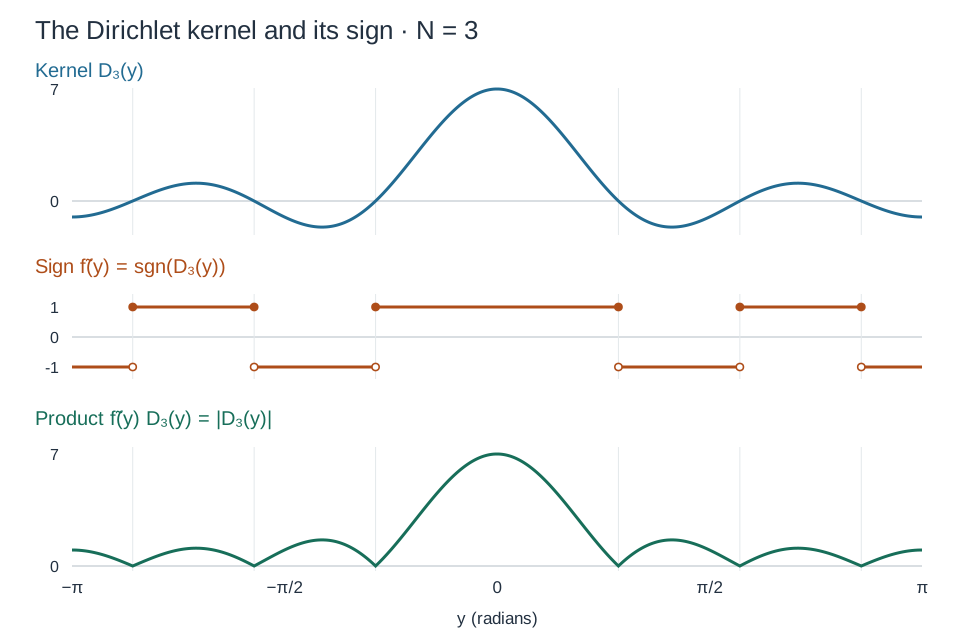
For fixed \(N\), let \(y_1,\ldots,y_m\) be the zeros of \(D_N\) in \([-\pi,\pi]\). For sufficiently large \(j\), the intervals \((y_k-1/j,y_k+1/j)\) are disjoint and lie inside \((-\pi,\pi)\). Define \(f_j=\widetilde f\) outside these intervals. Inside each interval, let \(f_j\) interpolate linearly between the values of \(\widetilde f\) at its endpoints. Then \(f_j\) is continuous and periodic, and \(\|f_j\|_\infty\le 1\).
For each \(y\) with \(D_N(y)\ne 0\), the intervals eventually shrink away from \(y\), so \(f_j(y)D_N(y)\to |D_N(y)|\). At a zero of \(D_N\), both sides are zero. Moreover,
Since \(|D_N|\) is integrable, the Dominated Convergence Theorem gives
Each \(f_j\) belongs to the closed unit ball, so \(|\Lambda_N f_j|\le\|\Lambda_N\|\). Taking the limit yields \(\|D_N\|_{L^1}\le\|\Lambda_N\|\). Combining the two bounds gives
We can also see why the integrals converge by estimating the error on the short intervals. Let \(E_j\) be their union. Its total length is \(2m/j\). Outside \(E_j\) the two functions agree, and inside \(E_j\) we have \(|f_j-\widetilde f|\le 2\). Hence
Here \(N\) is fixed, so both the number of zeros \(m\) and the maximum \(\|D_N\|_\infty\) are fixed as \(j\to\infty\).
Consequence for Pointwise Convergence
The normalized \(L^1\) norm of the Dirichlet kernel grows on the order of \(\log N\). The proposition therefore shows that \(\sup_N\|\Lambda_N\|=\infty\).
If the Fourier partial sums were bounded at the origin for every \(f\in C(\mathbb{T})\), the Uniform Boundedness Principle would give \(\sup_N\|\Lambda_N\|\lt\infty\), since \(C(\mathbb{T})\) is a Banach space. Consequently, there exists a continuous periodic function \(f\) for which
For this function, the Fourier partial sums diverge at the origin.
The Uniform Boundedness Principle
We will use the contrapositive. If the operator norms are unbounded, then there is a single input \(x\in V_1\) for which the outputs are unbounded:
Divergence of Fourier Partial Sums at the Origin
Proof
Recall that \(C(\mathbb{T})\) with the supremum norm is a Banach space. For each fixed \(N\), we have a bounded linear functional
We showed that \(\|\Lambda_N\|=\|D_N\|_{L^1}\). Since \(\|D_N\|_{L^1}\to\infty\) as \(N\to\infty\), it follows that
Apply the contrapositive of the Uniform Boundedness Principle to the family \((\Lambda_N)\). It gives a single function \(f\in C(\mathbb{T})\) such that
This is where the theorem matters: we can now keep the same \(f\) fixed as \(N\) varies. By the definition of \(\Lambda_N\), we have
Thus the sequence of partial sums at the origin is unbounded. Since every convergent sequence is bounded, the Fourier series of this \(f\) diverges at \(x=0\).
References
- SFSU Fourier Analysis by Professor Chun-Kit Lai
- Fourier Analysis: An Introduction by Elias M.Stein and Rami Shakarchi