We have two issues with (C[0,2\pi])? The first problem is that if we consider the the supremum norm doesn’t come from an inner product, so it doesn’t provide the orthogonality and orthogonal projections we need here. Why? It fails … [TODO]
The Problem with \(C([0,2\pi])\)
First note that the space \(C([0,2\pi])\) with the supremum norm is complete. We showed this previously in Topology? (TODO: a uniformly Cauchy sequence of continuous functions has a continuous uniform limit). However the supremum norm doesn’t come from an inner product, so it doesn’t provide the orthogonality and orthogonal projections we need here.
Unfortunately, if we instead consider using the integral inner product, then we still have a problem which is that \(C([0,2\pi])\) is NOT complete under the norm induced by the integral inner product. Why? consider the sequence of functions \(f_1,f_2,f_3,\ldots\) where each \(f_n\) is continuous:
- \(f_n\) equals \(0\) up to \(x=\pi\) and equals \(1\) afterward.
- \(f_n\) rises linearly from \(0\) to \(1\) over \([\pi,\pi+1/n]\).
As \(n\) increases, that interval gets narrower, so the ramp gets steeper pictured below
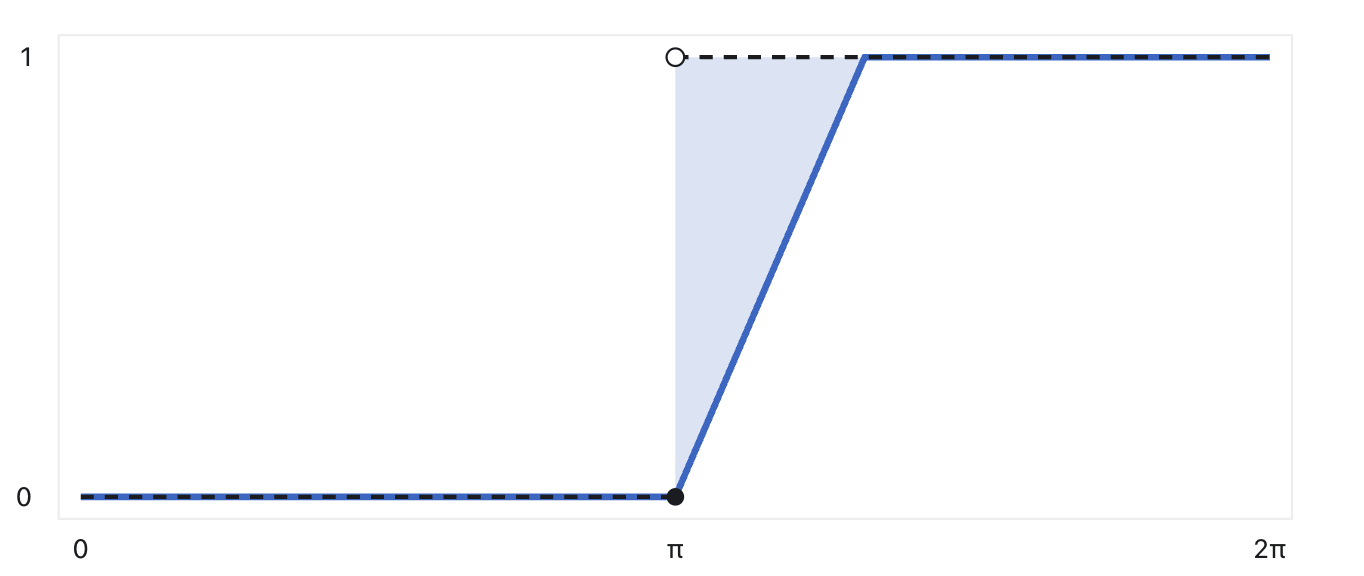
We define \(f_n\) by
and \(f\) by
The functions \(f_n\) differ from \(f\) only on an interval of width \(1/n\). The pointwise error is bounded by \(1\):
By the definition of convergence earlier, we want to show for all \(\epsilon > 0\), there exists an \(N\) such that whenever \(n \geq N\),
Now we use the error bound in \((1)\):
Given \(\epsilon>0\), choose an integer
Then whenever \(n\ge N\),
That proves \(f_n\to f\). But \(f\) is not continuous at \(x = \pi\). Hence \(f \not\in C[0,2\pi]\). However, \(f\) belongs to \(L^2([0,2\pi])\) because it is measurable and its squared magnitude has a finite integral:
So \(f\in L^2([0,2\pi])\), even though \(f \not \in C([0,2\pi])\).
References
- SFSU Fourier Analysis by Professor Chun-Kit Lai
- Fourier Analysis: An Introduction by Elias M.Stein and Rami Shakarchi