Solution
To start, we will just copy the prime generation function from past problems
void fill_primes(std::vector<int>& a, int count) {
    a.clear();
    a.reserve(count);
    for (int candidate = 2; a.size() < static_cast<std::size_t>(count);
         ++candidate) {
        bool prime = true;
        for (int p : a) {
            if (p > candidate / p) break;
            if (candidate % p == 0) {
                prime = false;
                break;
            }
        }
        if (prime) {
            a.push_back(candidate);
        }
    }
}
Next, we want to count the number of ways to write \(n\) as an unordered sum of prime numbers. We begin with the base case
because there is exactly one way to make \(0\): select no primes. All other entries are initially \(0\). We then consider each prime \(p\), from \(2\) through \(97\). While processing \(p\), count_sums[n] records the number of ways to make \(n\) using only primes up to \(p\). For each \(n\ge p\), we perform the update
Before the update, count_sums[n] contains the representations of \(n\) that do not use \(p\). For example, suppose we are calculating the number of ways to make \(9\) and are about to process the prime \(5\). Before processing \(5\), the known representations use only \(2\) and \(3\):
We then look at count_sums[9-5], which is count_sums[4]. There is one way to make \(4\) using the primes processed so far:
Adding \(5\) to this representation produces one new way to make \(9\):
Therefore, the update
adds the representation containing \(5\) (\(2 + 2 + 5\)) while still keeping the two representations that do not contain \(5\) (\(2+2+2+3\) and \(3+3+3\)). Hence we get
We process \(n\) in ascending order so that the current prime may be used repeatedly. Since the primes themselves are processed one at a time, different orderings of the same sum are not counted separately. Here is an initial run of sums up to \(6\):
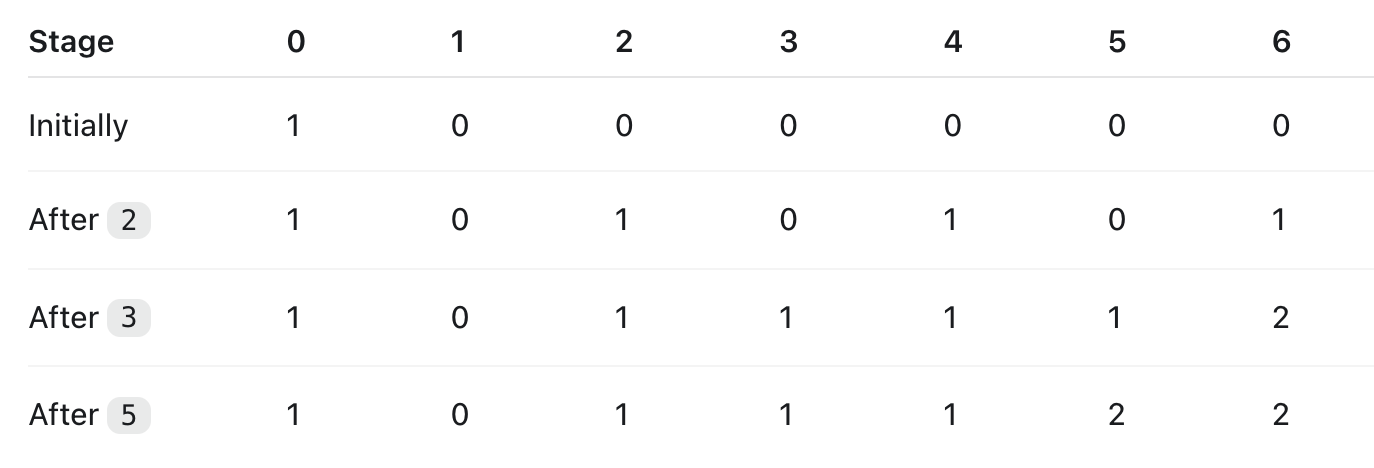
and the code is simply:
std::map<int, int> count_prime_sums(const std::vector<int>& primes, int max_sum) {
    std::map<int, int> sum_counts;
    sum_counts[0] = 1;
    for (int prime : primes) {
        if (prime > max_sum) continue;
        for (int sum = prime; sum <= max_sum; ++sum) {
            sum_counts[sum] += sum_counts[sum - prime];
        }
    }
    sum_counts.erase(0);
    return sum_counts;
}