Hence the tangent cone is the union of all rays that start at a point of the face \(F\), point toward a point \(y \in P\) and extend indefinitely beyond \(y\).
In other words, there is no ray starting at a point of \(F\), pointing toward a point of \(P'\) and extending indefinitely that passes through \(\mathbf v\). So \(\mathbf v\) must lie on the other side of the supporting plane of \(F\) so \(\mathbf v\) is “beyond” \(F\) as illustrated in the example below:
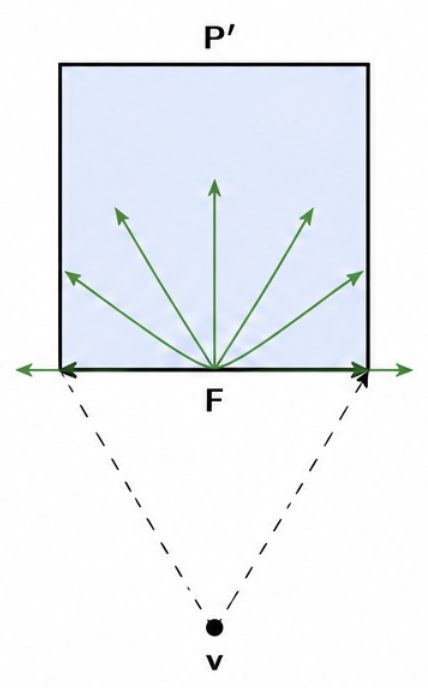
Equivalently, every point of \(F\) is visible from \(\mathbf v\). Now let \(\mathcal S'\) be a subdivision of \(P'\). We define
Note here that
since \(\mathcal{S'}\) is a subdivision of \(P'\). Thus, \(\operatorname{Vis}_{\mathbf v}(\mathcal S')\) consists precisely of those cells of the subdivision that are visible from \(\mathbf v\). Moreover \(T_{\varnothing}(\mathcal{S'}) = P'\) since the tangent cone of the empty face means we can target all the points in \(P'\) with no restriction. Also note that \(\varnothing \in \operatorname{Vis}_{\mathbf v}(\mathcal S')\) since \(\varnothing \in \mathcal{S'}\) and we established that \(T_{\varnothing}(\mathcal S') = P'\) and by assumption, \(v\notin P'\). Hence \(\varnothing\in \operatorname{Vis}_{\mathbf v}(\mathcal S')\).