- reflexive: \( (x \le x \text{ for all } x \in S) \)
- transitive: \( (x \le y \text{ and } y \le z \Rightarrow x \le z) \)
- antisymmetric: \( (x \le y \text{ and } y \le x \Rightarrow x=y) \).
Additionally a poset is denoted by \(S\), when the partial order is clear. Note that any subset of \(S\) is also a poset, with the induced partial order.
Example
Take the following triangle
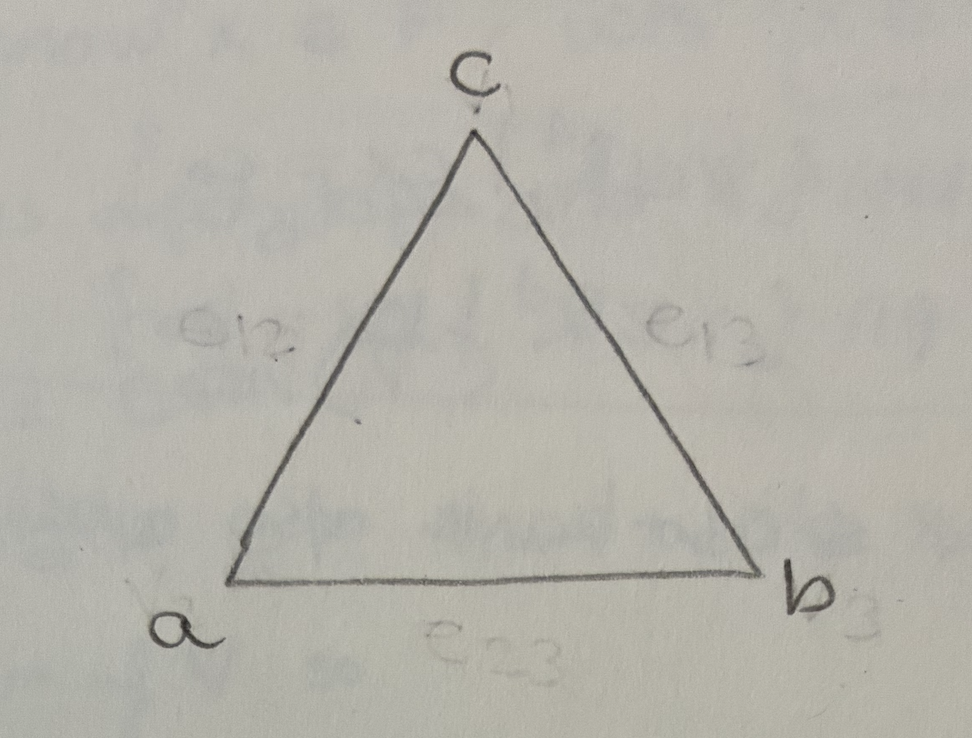
The faces are
- The whole triangle: \(P\)
- The edges: \(ab,bc,ac\)
- The vertices: \(a,b,c\)
- The empty face: \(\emptyset\)
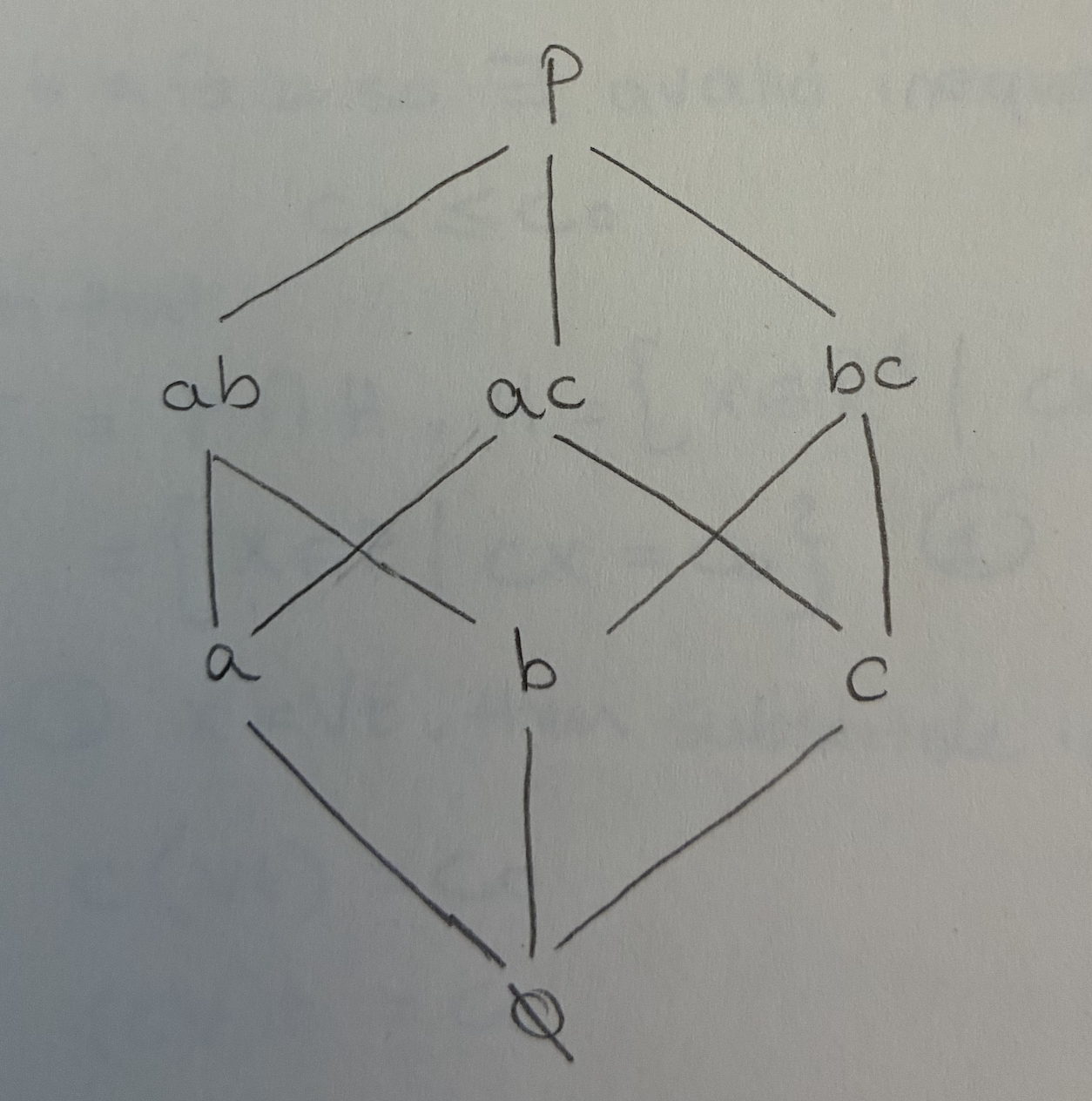
This makes a partially ordered set with order relation \(\subseteq\).
In the triangle above, an example of a chain is
Additionally, an interval in \(S\) is boolean if it is isomorphic to the poset
of all subsets of a \(k\)-element set, for some \(k\).
Is the triangle poset above bounded?
- It has a unique minimal element \(\hat{0} = \emptyset\)
- It has a unique maximal element \(\hat{1} = P\)
So it is bounded by the definition above.
In the triangle example, the maximal chains are all of the same length. One example is $$ \begin{align*} \emptyset \subset a \subset ab \subset P \end{align*} $$
The length of this maximal chain in \([\hat{0},P]\) is the rank of \(P\). We know the length is the number of elements minus 1 so its length is \(3\) which is also the rank of \(P\). Since it’s bounded and all the maximal chains are of the same length, then it is a graded poset by definition.
Note that once we establish that every maximal chain has the same length, then the definition of rank becomes well-defined. So we must establish every that \(L(P)\) is a graded poset before talking about the rank.
So take two elements \(a\) and \(b\) in the triangle example. An upper bound is any element that is above both \(a\) and \(b\). For example, \(ab\) and \(P\) are both upper bounds. The least upper bound however is \(ab\) and therefore it is unique. We call this a join. Notice that in the triangle example, for every two elements, we can also find a unique minimal upper bound (join) and a unique maximal lower bound (meet). Hence the triangle poset is a lattice.
Notice that in the triangle example, the atoms are \(a\), \(b\) and \(c\). The coatoms in this case are \(ab, ac\) and \(bc\).
For example \(a \prec ab\) is a cover relation since there are no faces between \(a\) and \(ab\). However \(a \prec P\) is not a cover relation.
In this example, the face lattice is