per the textbook, the Farkas lemma gives us a characterization for the solvability of linear inqualities. The first version is as follows:
Proposition 1.7 (Farkas Lemma (I))
Let \(A\in\mathbb{R}^{m\times d}\) and \(z\in\mathbb{R}^{m}\).
Either there exists a point \(x\in\mathbb{R}^{d}\) with \(Ax\leq z\),
or there exists a row vector \(c\in(\mathbb{R}^{m})^*\) with
\(c\geq0\), \(cA=0\), and \(cz<0\),
but not both.
Proof
Let
$$
\begin{align*}
A=
\begin{bmatrix}
- & a_1 & -\\
- & a_2 & -\\
& \vdots & \\
- & a_m & -
\end{bmatrix}
\in \mathbb{R}^{m\times d}, \quad
x=
\begin{bmatrix}
x_1\\
x_2\\
\vdots\\
x_d
\end{bmatrix}
\in\mathbb{R}^d, \quad
Ax=
\begin{bmatrix}
a_1x\\
a_2x\\
\vdots\\
a_mx
\end{bmatrix}.
\end{align*}
$$
Hence the system \(Ax\le z\) is equivalent to the collection of inequalities
$$
\begin{align*}
a_1x&\le z_1,\\
a_2x&\le z_2,\\
&\vdots\\
a_mx&\le z_m.
\end{align*}
$$
Next, we show that only one condition can hold and not both. Suppose for the sake of contradiction that both conditions hold. Then, there exists \(x \in \mathbb{R}^d\) with \(Ax \leq z\) and there exists a row vector \(c \geq 0\) such that \(cA = 0\) and \(cz < 0\). Observe that
$$
\begin{align}
(cA)x = 0x = 0 \tag{1}
\end{align}
$$
Since \(c \geq 0\) and \(Ax \leq z\), multiply each inequality by the corresponding nonnegative coefficient of \(c\) and add them together to get
$$
\begin{align*}
c(Ax)\le cz
\end{align*}
$$
The left hand side is \(0\) by (1) but \(cz < 0\). Hence this is a contradiction and only one condition can be true.
Next we need to show that if condition one fails so there is no \(x\) satisfying \(Ax \leq z\), then condition two must hold. That is, there must exist a row vector \(c \geq 0\) satisfying the second condition. That is,
$$
\begin{align*}
cA=0
\qquad\text{and}\qquad
cz<0.
\end{align*}
$$
But before we continue, what does this mean even? If there is no \(x\) satisfying \(Ax \leq z\), then the Polyhedron \(P\) is empty. Now what is \(Ax\)? recall that each row of the matrix \(A\) is a normal vector pointing away from the allowed side of the halfspace. why? take any inequality and re-write as a dot product as follows
$$
\begin{align*}
2x_1 + 3x_2 &\leq 6 \\
\begin{bmatrix}
2\\
3
\end{bmatrix} \cdot \begin{bmatrix}
x_1\\
x_2
\end{bmatrix} &\leq 6
\end{align*}
$$
Hence \((2 \quad 3)^{T}\) is the normal vector which is prependicular to the surface. Since \(6 > 0\), this hyperplane is shifted forward in the direction of the normal vector, hence the hyperspace will contain the origin now.
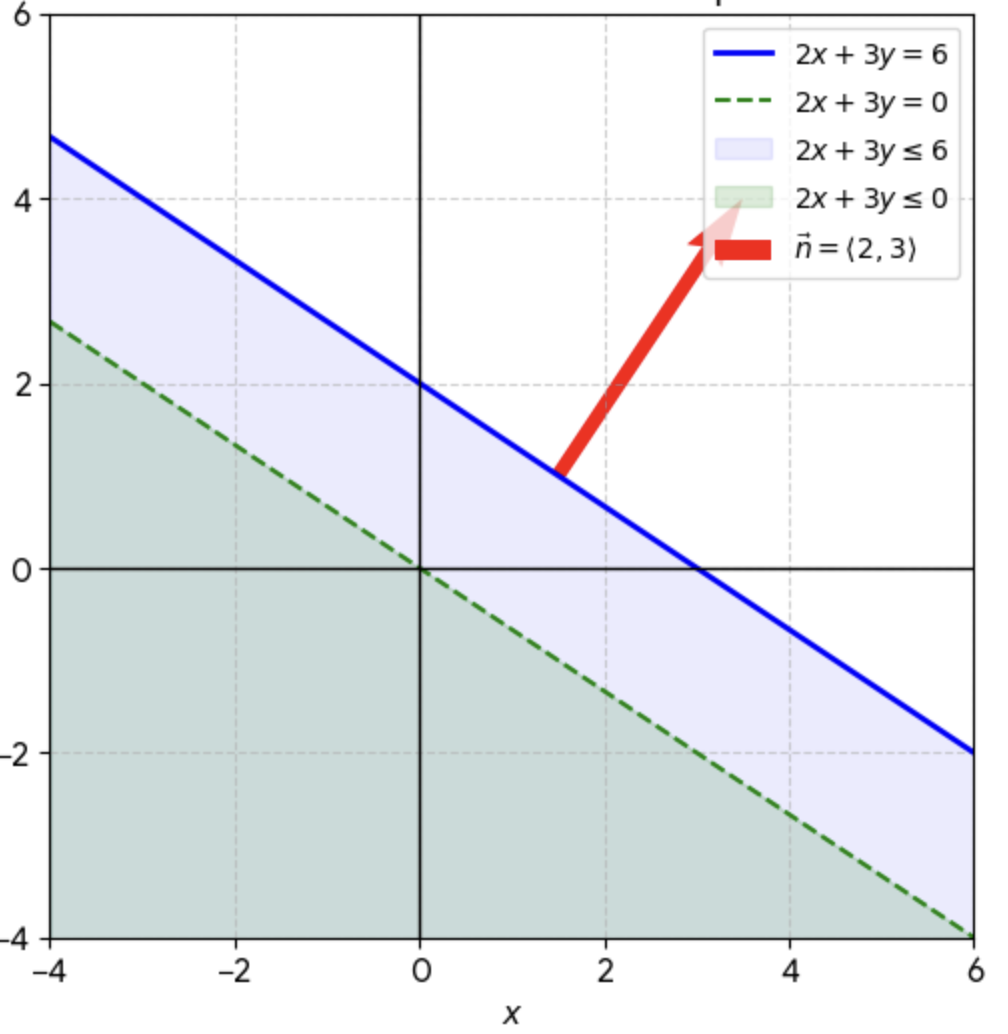
Now let's study what it means for \(cA\) to be zero. When we multiply \(c \geq 0\) by \(A\), we are taking a linear combination of these vectors so
$$
\begin{align*}
cA=
\begin{bmatrix}
c_1 & c_2 & \cdots & c_m
\end{bmatrix}
\begin{bmatrix}
- & a_1 & -\\
- & a_2 & -\\
& \vdots & \\
- & a_m & -
\end{bmatrix}
=
c_1a_1 + c_2a_2 + \cdots + c_ma_m
\end{align*}
$$
What kind of linear combination is this? Recall
- Affine combination: if the coefficients \(c_i\) sum to \(1\).
- Convex combination: The coefficients must sum to \(1\) and be non-negative
- Conical combination: The coefficients are only required to be non-negative. \(\text{cone}(a_1,\cdots,a_m) = \{c_1a_1 + \cdots + c_ma_m \mid c_i \geq 0\}\)
Hence this is a conical combination of the rows \(a_1,a_2,\cdots,a_m\). What about \(cA = 0\)? this means find a point in the conical hull of the rows of \(A\) that lands at the origin.
But let’s do another concrete example
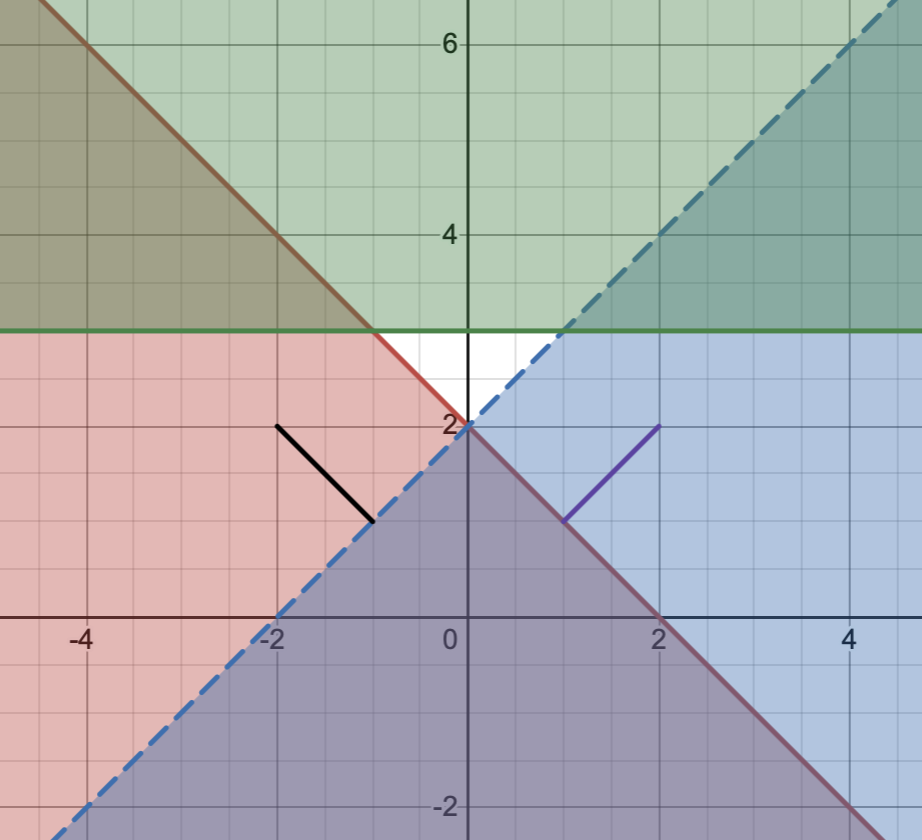
Take the inqualities that defines the following halfspaces
$$
\begin{align*}
x+y &\leq 2 \\
-x + y &< 2 \\
0x -2y &\leq -6
\end{align*}
$$
Clearly there are no solutions that satifies all three inequalities. So we expect condition two to hold. That is, we should be able to find a row vector \(c \geq 0\) such that \(Ac = 0\) and such that \(cz < 0\). Take the vector \((1 \quad 1 \quad 1)\). Now observe that
$$
\begin{align*}
cA =
\begin{bmatrix}
1 & 1 & 1
\end{bmatrix}
\begin{bmatrix}
1 & 1 \\
-1 & 1 \\
0 & -2
\end{bmatrix}
=
\begin{bmatrix}
0 & 0
\end{bmatrix}
\end{align*}
$$
Moreover,
$$
\begin{align*}
cA =
\begin{bmatrix}
1 & 1 & 1
\end{bmatrix}
\begin{bmatrix}
2 \\
2 \\
-6
\end{bmatrix}
= -2 < 0
\end{align*}
$$
So we can see that it at least works!
Back to the proof. Recall that we assumed that the first statement is false. That is, there is no \(x\) satisfying \(Ax \leq z\). We want to show that condition two must hold. That is, there must exist a row vector \(c \geq 0\) satisfying \(cA = 0\) and \(cz < 0\). The textbook defines
$$
\begin{align*}
P = P(A,z) &= \{x \in \mathbb{R}^d \mid Ax \leq z\}
\end{align*}
$$
and
$$
\begin{align*}
Q = P((-z,A),0) &= \{ (x_0,x) \in \mathbb{R}^{d+1} \mid (-z, A)
\begin{bmatrix}
x_0 \\
x
\end{bmatrix} \leq 0\} \\
&= \{ (x_0,x) \in \mathbb{R}^{d+1} \mid -x_0z + Ax \leq 0 \} \\
&= \{ (x_0,x) \in \mathbb{R}^{d+1} \mid Ax \leq x_0z \}
\end{align*}
$$
What is \(Q\)? Note above that for any \((x_0,x) \in Q\) and every \(\lambda \geq 0\), we can multiply \(\lambda\) on both sides since it’s not negative to get
$$
\begin{align*}
Ax \leq x_0 z \\
\lambda Ax \leq \lambda x_0 z
\end{align*}
$$
Hence \((\lambda x_0, \lambda x) \in Q\). But this implies by definition that \(Q\) is an \(\mathcal{H}\)-cone. Next, the textbook claims that
an $$x \in \mathbb{R}^d$$ exists with $$Ax \leq z$$ if and only of $$Q$$ contains a point with $$x_0 > 0$$.
Why? suppose that \(P(A,z)\) is not empty. This implies that there exists some point \(x \in \mathbf{R}^d\) such that \(Ax \leq z\). Choosing \(x_0=1\), we see that \((1,x) \in Q\) since \(Ax \leq 1z\). Conversely, suppose \(Q\) contains a point \((x_0,x)\) with \(x_0 > 0\). Then by definition of \(Q\)
$$
\begin{align*}
Ax &\leq x_0z \\
A \frac{x}{x_0} &\leq z \quad \text{(since $x_0 > 0$)}\\
\end{align*}
$$
But this implies that \(\frac{x}{x_0} \in P(A,z)\). This proves the claim. By assumption, we know that there is no \(x\) satisfying \(Ax \leq z\). By the claim, this means that \(Q\) contains no point with \(x_0 > 0\). Now, use Fourier-Motzkin elimination to eliminate \(x_1,\cdots,x_d\). What’s left is just inequalities in terms of \(x_0\) and since \(x_0\) can’t be greater than \(0\), then all the inqualities must have the form
$$
\begin{align*}
\gamma_i x_0 \leq 0
\end{align*}
$$
Since Fourier-Motzkin preseves the \(\leq\) form. Moreover, only inequalities with at least one \(\gamma > 0\) would force having \(x_0 \leq 0\) (remember that \(Q\) has no point with \(x_0 > 0\)). So fix this inequality with \(\gamma > 0\) and \(\gamma x_0 \leq 0\). Then, we want where this inequality came from during the elimination process.
….[TODO…]
References