A Ferrers graph is just a representation of a partition as dots with the nth row having the same number of dots as the nth term in the partition. If we transform a Ferrers graph so that each row becomes a column, then this transformation is called conjugation as shown below:
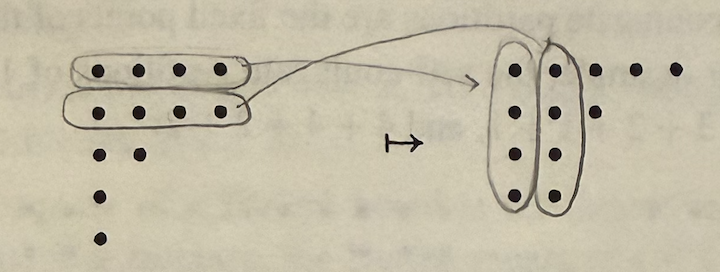
This transformation returns a partition where the greatest part in it is equal to the number of parts in the original partition. Hence we get the identity
$$
\begin{align}
p(n \mid m\text{ parts}) = p(n \mid \text{greatest part is } m)
\end{align}
$$