Notes
What is this theorem or exercise saying? We’re just looking to show that in the following graph
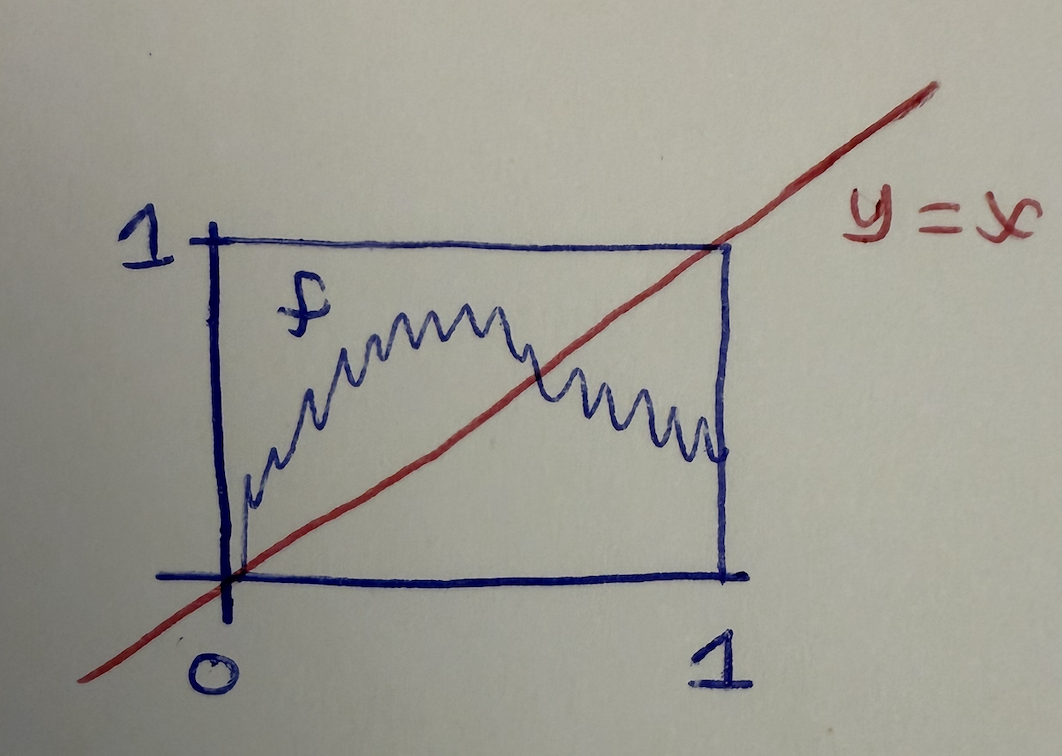
We must hit the diagonal at some point. Since \(f\) is continuous on a closed and bounded interval, then IVT says we can draw the function in a single stroke and every point in the range gets hit. Therefore, we must hit some point on that diagonal. To show this, we do the same thing we did in the IVT proof. Translate the function down so define \(g(x) = f(x)-x\). Then, if \(g(x) > 0\), we’re above the diagonal. If \(g(x) < 0\), we’re below the diagonal and if \(g(x) = 0\), then \(y=x\).
Proof
First note that \(f(0) \geq 0\) and \(f(1) \leq 1\). Now, consider \(g(x) = f(x) - x\). Then
Hence \(0\) lies between \(g(0)\) and \(g(1)\). Since \(g(0) \geq 0\) and \(g(1) \leq 0\). The intermediate value theorem says that there exists some point \(x_0 \in (0,1)\) such that
This means that
References
- Introduction to Analysis, An, 4th edition by William Wade
- Lecture Notes by Professor Chun Kit Lai