Example:
- The group \(SO(3)\), the special orthogonal matrices is a subgroup of \(GL_3(\mathbb{R}\), the group of invertible \(3 \times 3\) matrices. Both of these are under the same operation.
- Non-example: \(\mathbb{Z}_n\): congruence classes modulo \(n\) with addition. We also have \(\phi(n)\): congruence classes with multiplicative inverses. This has the operation multiplication so it's not a subgroup! Even when you define \(\phi(4) = \{[1],[3]\}\) with addition, it will not satisfy the group requirements, so it's not a subgroup.
Since we need to check a lot for subgroups. We have a set of necessary conditions.
- \(H\) is not empty
- \(H\) is closed under multiplication. That is, for all elements \(h_1\) and \(h_2\) of \(H\), the products \(h_1h_2\) is also an element of \(H\)
- \(H\) is closed under inverses. For all \(h \in H\), the inverse \(h^{-1}\) is an element of \(H\)
Proof
- \(H\) is associative. For any \(a,b,c \in H\), \((ab)c = a(bc)\). We're inheriting the same operation from \(G\) so \(H\) must be associative.
- \(H\) has an identity element: We know \(H\) is non-empty by (1). We also know for any \(h \in H\), \(h^{-1} \in H\) by (3). By (2), \(H\) is closed under multiplication so \(hh^{-1} \in H\) but \(hh^{-1} = e\) so the identity element is in \(H\).
Example
Consider the group \(G = S_4\) (permutations of \(\{1,2,3,4\}\)). The order of this group is \(|G| = 4\). The following are subgroups of \(S_4\):
- \(H=\{ \sigma \in S_4 \ | \ \sigma(4) = 4\}\). So this subgroup fixes \(4\) in the permutation. \(|H| = 3! = 6\). In fact, it is permuting only 3 numbers and it is isomorphic to \(S_3\).
- \(H'=\{e,(1 \ 2)(3 \ 4), (1 \ 3)(2 \ 4), (1 \ 4)(2 \ 3)\}\). It's not empty. It has the identity element. Every element is its own inverse. The one thing not too obvious is proving it is closed. This subgroup is isomorphic to the symmetry group of the rectangle. What's an isomorphism in this case? Assign \(A\) to 1, \(B\) to 2, \(C\) to 3, \(D\) to 4. Recall that the symmetries of the rectangle has the symmetries \(r_1, r_2, r_3, e\) where \(r_1\) is rotating around the \(x-\)axis. Observe now that \(r_1\)
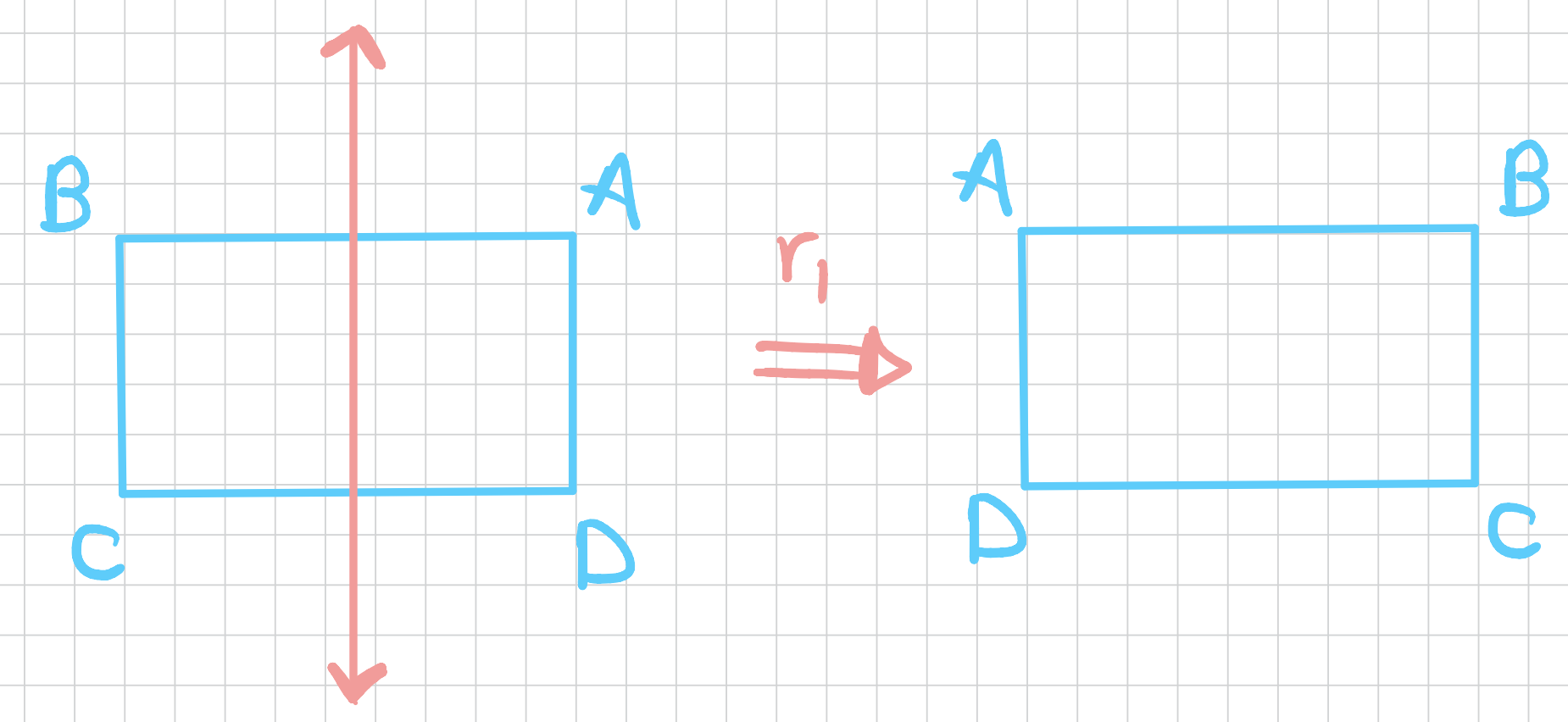 rotates the vertices such that \(A\) and \(B\) switch positions and \(C\) and \(D\) switch positions. This is equivalent to the permutation \((1 \ 2)(3 \ 4)\). Following this, we'll see that \(r_2\) gets mapped to \((1 \ 4)(2 \ 3)\) and \(r_3\) gets mapped to \((1 \ 3)(2 \ 4)\).
- \(H''=\{e,(1 \ 2 \ 3 \ 4)(4 \ 3 \ 2 \ 1), (1 \ 2)(3 \ 4), (1 \ 3)(2 \ 4), (1 \ 4)(2 \ 3), (1 \ 3),(2 \ 4)\}\). This one is isomorphic to \(D_4\) which is the symmetries of the square.
Generated Subgroups
We begin with the following lemma which states that the intersection of a collection of subgroups is another subgroup.
Proof
- Every \(H_i\) is a subgroup. Therefore \(e \in H_i\) for each \(i\) and thus \(e \in H\).
- For any two elements \(a, b \in H\), we must have \(a, b \in H_i\) for each \(i\). Their product \(ab\) must also be in every \(H_i\) since each \(H_i\) is a subgroup. Therefore \(ab \in H\).
- For any \(a \in H\), \(a\) must be in \(H_i\) for each \(i\). Therefore \(a^{-1} \in H_i \ \forall i\) and thus \(a^{-1} \in H\).
Since any intersection of subgroups is another subgroups, we can then define a generated subgroups as follow
Observe that
- \(\langle S \rangle\) is a subgroup by the previous lemma since it is the intersection of subgroups.
- \(S \subseteq \langle S \rangle\).
- It is the smallest group that contains \(S\). Because for any subgroup \(K \leq G\) such that \(S \subseteq K\), we must have \(\langle S \rangle \leq K\) (why? because if \(S\) is contained in \(K\) and \(K\) is a group, then all the products of the elements of \(S\) are in \(K\). Same for the inverses. So the whole subgroup \(\langle S \rangle\) must also be contained in \(K\).)
Additionally from the book:
- If \(S\) contains a single element, \(S = \{a\}\), then the subgroup generated by \(S\) is denoted by \(\langle a \rangle\).
- If \(G = \langle S \rangle\), then \(G\) is generated by \(S\) or \(S\) generates \(G\)
Another way to describe \(\langle S \rangle\) is take a bottom up approach to describe the elements.
In other words, \(\langle S \rangle\) is a subgroup such that that it contains all the possible products \(g_1g_2...g_n\) which are in \(S\) or an inverse to an element of \(S\). The set that contains such products is often called the “set of words in \(S\)” in group theory.
Proof
Let \(T\) be the set of words \(\{e\} \cup \{g_1...g_k\}\) where \(g_i \in S\) or \(g_i^{-1} \in S\) for all \(i = 1,...,k\). We need to show that
- \(T\) is a subgroup of \(G\). [This is true because \(T\) has the identity element. For any two word, the product of these is just a longer word which is also in \(T\). It is closed under the inverses because \((g_1g_2...g_k)^{-1} = g_k^{-1}...g_1^{-1}\).]
- \(S \subseteq T\). [This is true because all the words of length 1 make up the set \(S\). It is true by construction.]
- If \(K \leq G\) is a subgroup such that \(S \subseteq K\), then \(T \subseteq K\). [This is true because if \(K\) contains \(S\) then it must contain all the inverses of these words and then also the products of all of these words since it's a group (closed) so it has all of these elements and it contains \(T\) itself.]
Condition (1) and (2) imply that \(\langle S \rangle \subseteq T\). Conditions (1) and (3) imply that \(T \subseteq \langle S \rangle\). Therefore, \(T = \langle S \rangle\). \(\ \blacksquare\) We’ll use this proposition a lot.
Lattice of Subgroups
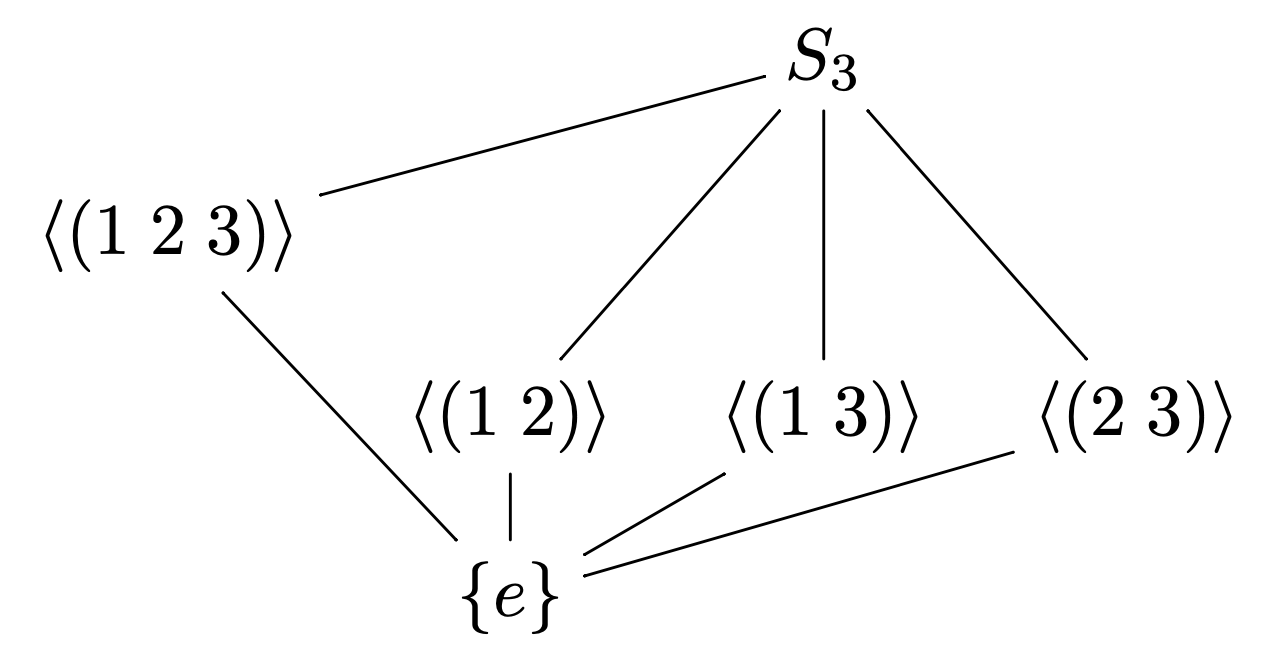
Consider the group \(S_3 = \{e, (1 \ 2), (1 \ 3), (2 \ 3), (1 \ 2 \ 3), (1 \ 3 \ 2)\}\). We can list its subgroups in terms of its generating subsets as follows:
- \(\langle (1 \ 2) \rangle = \{e, (1 \ 2)\}\). This says that the subgroup generated by \(\{(1 \ 2)\}\) is \(\{e, (1 \ 2)\} = \langle (1 \ 2) \rangle \)
- \(\langle (1 \ 3) \rangle = \{e, (1 \ 3)\}\).
- \(\langle (2 \ 3) \rangle = \{e, (2 \ 3)\}\).
- \(\langle (1 \ 2 \ 3) \rangle = \{e, (1 \ 2 \ 3), (1 \ 3 \ 2)\}\) = \(\langle (1 \ 3 \ 2) \rangle\)
- \(S_3 = \langle (1 \ 2), (1 \ 2 \ 3) \rangle\).
We can then draw this in the following figure
Notice also that \(S_4 = \langle (1 \ 2 \ 3 \ 4), (2 \ 4) \rangle\).
Cyclic Groups and Cyclic Subgroups
We’ll start with the definition
In fact, we can describe all the elements in a cyclic subgroup as follows
Note here that this subgroup is abelian!
Proof (book)
Let \(H = \{a^k \ : \ k \in \mathbb{Z}\}\). We will show that \(\langle a \rangle = H\) as follows:
\(\langle a \rangle \subseteq H\): We know that \(G\) is a group and \(H\) is subset of \(G\). We claim that it is a subgroup of \(G\). It is closed under multiplication because for any \(a^k\) and \(a^l\) in \(H\), \(a^{k+l} \in H\). It is closed under inverses because for any \(a^k \in H\), \((a^{k})^{-1} = a^{-k} \in H\). Furthermore, \(H\) contains \(a\) and since \(H\) is a subgroup, then \(H\) contains all the powers of \(a\). Therefore, \(\langle a \rangle \subseteq H\).
\(H \subseteq \langle a \rangle\): We showed that \(H = \{a^k \ : \ k \in \mathbb{Z}\}\) is a subgroup above. It is closed under multiplication and so it contains all powers of \(a\). Therefore, \(H \subseteq \langle a \rangle\). \(\ \blacksquare\)
Example
Suppose \(G = (\mathbb{Z}, + )\). For any element \(a \in \mathbb{Z}\),
- The set of powers of \(a\) is the set of all multiples of \(a\) since the group operation is addition. So \(a+a+a+a+a\) is the fifth power.
- If \(a = 0\), then \(\langle a \rangle = \mathbb{Z}0 = \{0\}\) is the trivial subgroup.
- If \(a \neq 0\), then \(\mathbb{Z}a\) is infinite. In fact it is isomorphic to \(\mathbb{Z}\) so \(\mathbb{Z}a \approx \mathbb{Z}\).
- Note here that \(\mathbb{Z} \neq \mathbb{Z}a\) unless \(a = \pm 1\).
- Also note, that \(\langle a \rangle = \langle -a \rangle\).
Now consider \(a, b \in \mathbb{Z}\). Suppose we want to find the subgroup generated by the set of \(\{a,b\}\), In other words, \(\langle a,b \rangle\). This is the set of all words composed of \(a\) and \(b\) and their inverses. In fact this is the set of all integer combinations of \(a\) and \(b\)
This is also a cyclic subgroup because \(\langle a, b \rangle = I(a,b) = \mathbb{Z}d\) where \(d = gcd(a,b)\) So the gcd is the generator of this subgroup. In fact, we will see next that all subgroups of \(\mathbb{Z}\) are cyclic
Cyclic Subgroups in \(\mathbb{Z}\)
- All subgroups of \((\mathbb{Z}, +)\) are cyclic except for the trivial subgroup \(\langle 0 \rangle = \{0\}\).
- All subgroups are infinite.
- Each subgroup is generated by a unique \(d \geq 0\).
- Each non-trivial subgroup is isomorphic to \(\mathbb{Z}\).
Proof (1)
To prove that all subgroups are cyclic, we need to find a generator for each of the subgroups. We have two cases:
If \(H = \{0\}\), then \(H = \mathbb{Z}0\) and we are done.
If \(H \neq \{0\}\), then \(H\) has at least a non-zero element. By the well ordering principle of \(\mathbb{N}\), there is a smallest element \(d \in H \cap \mathbb{N}\) (\(d\) is the smallest positive element in \(H\)). We claim that \(H = \mathbb{Z}d\).
\(\mathbb{Z}d \subseteq H\): We know \(d \in H\) and \(H\) is a group. Therefore, any multiple of \(d\) is in \(H\) since it must be closed so \(\mathbb{Z}d \subseteq H\) as required.
\(H \subseteq \mathbb{Z}d\): Suppose \(x \in H\). We want to show that \(x\) is a multiple of \(d\). Use division with remainder (\(x \div d\)) to get \(x = qd + r\) such that \(q, r \in \mathbb{Z}\) and \(0 \leq r < d\). Observe now that
\(x \in H\) by assumption. \(qd \in H\) since \(d \in H\). Therefore, we must have \(r \in H\). But \(d\) is the smallest positive element in \(H\) by the hypothesis and \(r < d\) so \(r\) must be zero. Therefore, \(x = qd \in \mathbb{Z}d\) and \(H = \mathbb{Z}d\) as we wanted to show. \(\ \blacksquare\).
Lattice of subgroups of \(\mathbb{Z}\)
We can organize all the subgroups of \(\mathbb{Z}\) in a lattice ordered by the subset relation. For example the all the multiples of 4 are contained in the multiples of 2, so \(\mathbb{Z}4 \subset \mathbb{Z}4\) and it it goes under \(\mathbb{Z}2\) and so. This lattice is also a divisibility lattice meaning that if \(\mathbb{Z}a \subseteq \mathbb{Z}b\), then \(b \ | \ a\). For example we see that \(\mathbb{Z}6 \subset \mathbb{Z}3\) in the lattice and so this implies that \(3 \ | \ 6\).

[TODO add pic]
Order of an Element
Suppose \(G\) is a group and \(a \in G\), then we denote the order of an element by \(o(a)\). We will define the order of \(a\) is as follows
This says that the order of an element is equal to the size of its generated subgroup \(\langle a \rangle\). But in an earlier lecture, we also defined the order of an element as follows
- If \(o(a) = n\), then \(n\) is the least positive integer such that \(a^n = e\). Furthermore, \(\langle a \rangle = \{a^k \ : \ 0 \leq k < o(a)\}\).
- If \(o(a) = \infty\), then \(a^n \neq e \ \forall n\).
The claim is that these are equivalent. We will assume the definition and prove that it is equivalent to the order being the smallest positive integer such that \(a^n = e\).
Proof
By definition, the cyclic subgroup generated by \(a\) is \(\langle a \rangle = \{a^k \ | \ k \in \mathbb{Z} \}\). Suppose that \(o(a) = |\langle a \rangle| = n\). Since \(\langle a \rangle\) is finite, then two powers of \(a\) must coincide. So \(a^i = a^{j}\) for some \(i < j\). This means that \(a^{j-i} = e\) where \(k = j - i > 0\) (side note: why? think of the integers mod 7 with addition, \(2^2 = 2+2\) and \(2^9=18\) both leave a remainder of 4. While \(2^7\) is \(e\)). By the well-ordering principle, there a least \(k\) such that \(a^k = e\), We want to show that \(k\) is equal to the order of \(\langle a \rangle\) which is \(n\).
Now, suppose we have some power \(m\) of \(a\). Write \(m = kq + r\) where \(0 \leq r < k\) and \(r = rem_k(m)\). So \(a^m = (a^k)^qa^r = a^qa^r = a^r\). This means that
Since \(n\) is the size of the set by assumption, then \(n \leq k\). But that means that that we have two powers in the set above that must coincide where \(a\) raised to the power of their difference is the identity element. But this is a contradiction since we said that \(k\) is the smallest positive number such that \(a^k = e\). Therefore, we must have \(n = k\). So the minimality of \(k\) implies their equality.
If \(\langle a \rangle\) is infinite, we can use the same argument to show that if \(a^k = e\) for some \(k > 0\), then all elements can be written as \(\langle a \rangle = \{e, a, a^2, ..., a^{k-1}\}\) but this is a finite set which is a contradiction. \(\ \blacksquare\)
The notion of order leads to the following result
- If \(a\) has infinte order, then \(\langle a \rangle\) is isomorphic to \(\mathbb{Z}\)
- If \(a\) has finite order, then \(\langle a \rangle\) is isomorphic to the group \(\mathbb{Z}_n\)
Proof (book)
For \((a)\), we want to show this by finding an example of an isomorphism. So define the map
To show that this map is an isomorphism, we need to show that it is a bijection and also that for any two elements \(a, b \in \mathbb{Z}\), \(\varphi(ab) = \varphi(a)\varphi(b)\) (Definition 2.1.13).
To show that it is a bijection, observe that this map is surjective or onto by the definition of \(\langle a \rangle\). (Recall that that \(\langle a \rangle\) is of infinite order). It is also injective or 1-1 because all the elements of \(\langle a \rangle\) (powers of \(a\)) are distinct. Furthermore, observe that for any \(k, l \in \mathbb{Z}\)
So \(\varphi\) is an isomorphism.
Similarly for \((b)\), we want to define an isomorphism. Note here that both \(\mathbb{Z}_n\) and \(\langle a \rangle\) have \(n\) elements so define the map
where \(0 \leq k \leq n-1\). In \(\mathbb{Z}_n\), This map is both injective and surjective. Furthermore, observe that \([k] + [l] = [k+l]\) but since we’re module class \(n\), then \([k+l] = [qn + r] = [0 + r] = [r]\) so
while,
Therefore \(\varphi\) is an isomorphism.
Subgroups of \(\mathbb{Z}_{12}\)
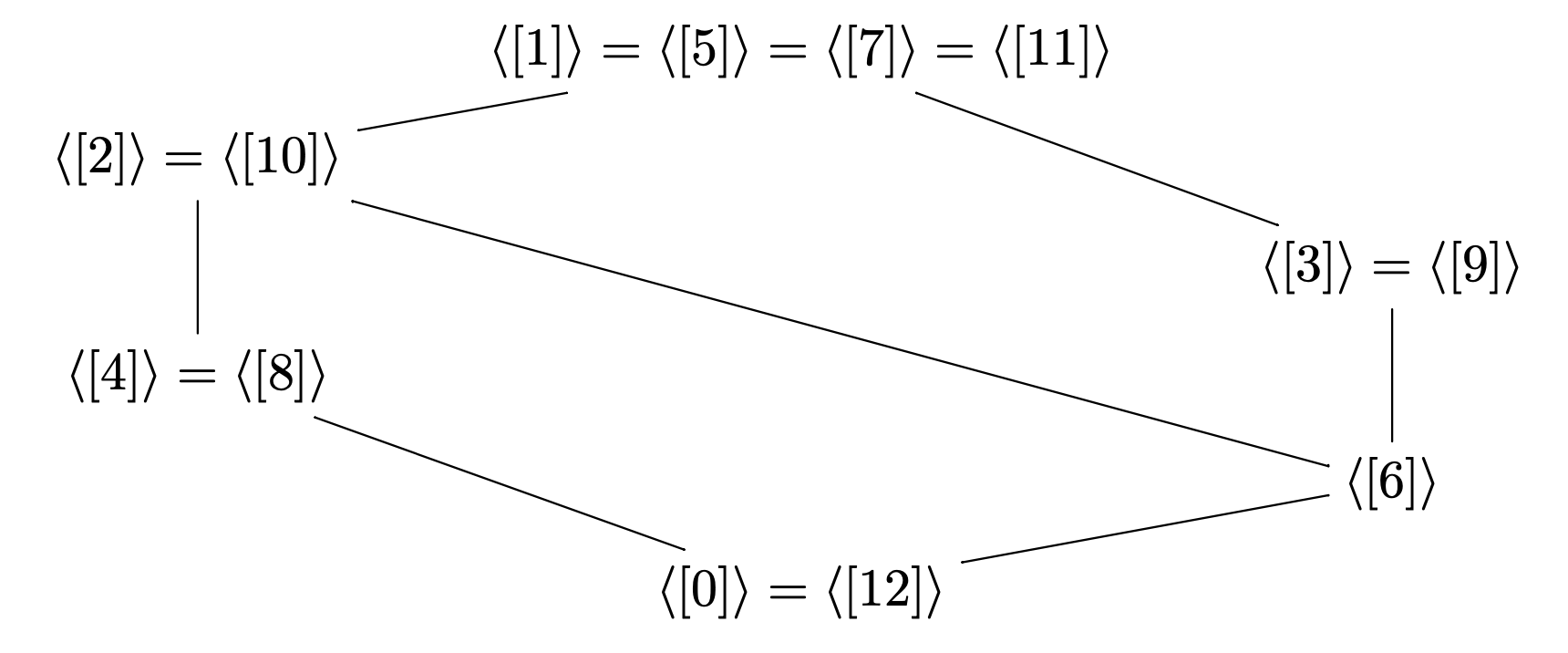
We can also build a lattice for the subgroups of \(\mathbb{Z}_{12}\).
Note that
- \(\langle [1] \rangle = \mathbb{Z}_{12} = \langle [5] \rangle = \langle [7] \rangle = \langle [11] \rangle\).
- \(\langle [2] \rangle = \{[0],[2],[4],[6],[8],[10]\}\).
- \(\langle [3] \rangle = \{[0],[3],[6],[9]\}\).
- \(\langle [4] \rangle = \{[0],[4],[8]\}\).
- \(\langle [6] \rangle = \{[0],[6]\}\).
- \(\langle [12] \rangle = \{[0]\}\).
Subgroups in the Finite Cyclic Group \(\mathbb{Z}_n\)
- Every subgroup of \(\mathbb{Z}_n\) is cyclic.
- If \(a \in \mathbb{Z}\), then \(\langle [a] \rangle = \langle [d] \rangle\) where \(d = gcd(a,n)\).
- If \(a, b \ | \ n\), then \(\langle [a] \rangle \subseteq \langle [b] \rangle\) if and only if \(b \ | \ a\).
- Every subgroup of \(\mathbb{Z}\) is \(\langle d \rangle\) for a unique \(d > 0\), \(d \ | \ n\) and \(|\langle d \rangle| = \frac{n}{d}\).
\((2)\) simply says that the standard representative/generator of the cyclic subgroup \(\langle a \rangle\) is \(gcd(a, n)\). We can replace \(a\) with \(gcd(a,n)\). They both represent the same congruence class.
\((3)\) is similar to \(\mathbb{Z}\). Recall that \(\mathbb{Z}2\) (multiples of 2) contains the subgroup \(\mathbb{Z}4\) and we concluded that \(\mathbb{Z}4 \subseteq \mathbb{Z}2\) implies that \(2 \ | \ 4\). A similar thing here.
To prove this theorem we need the following lemma:
So \(H\) is a set of integers such that the elements are the representatives of the congruence classes in \(\mathbb{Z}_n\). The proof of this lemma is in the lecture notes.
Theorem Proof
For (1), Let \(H \leq \mathbb{Z}_n\) be a subgroup. We want to show that \(H\) is cyclic by proving that \(H\) is a cyclic group generated by some element. Consider \(\tilde{H}\). Since \(H\) is a subgroup, then \(\tilde{H}\) is a subgroup of \(\mathbb{Z}_n\) by the lemma. Moreover, \(\tilde{H} = \mathbb{Z}d\) for some \(d \in \mathbb{Z}\) by the previous theorem (every subgroup of \(\mathbb{Z}\) is cyclic and is generated by some \(d\)). Therefore, by the definition of \(\tilde{H}\), \([d]\) must be a congruence class in \(H\). This implies that \(\langle [d] \rangle \subseteq H\) since \(H\) is a group and all multiples of \(d\) must be in \(H\).
To prove the other direction \(H \subseteq \langle [d] \rangle\), consider \([a] \in H\). This means that \(a \in \tilde{H}\) by the definition of \(\tilde{H}\). But \(\tilde{H} = \mathbb{Z}d\) so \(a\) is a multiple of \(d\) and we can write \(a = sd\) for some \(s \in \mathbb{Z}\). Therefore, \([a] = s[d]\) and \([a] \in \langle [d] \rangle\). Therefore, \(H = \langle d \rangle\) and \(H\) is cyclic as we wanted to show. \(\ \blacksquare\)
For (2), suppose that \(d = gcd(a,n)\). We want to show that \(\langle [a] \rangle = \langle [d] \rangle\). Since \(d\) is the gcd, then \(d\) divides both \(a\) and \(n\). Also \(d = I(a,n)\) and we can write \(d = sa + tn\) for some \(s, t \in \mathbb{Z}\).
Since \(a \ | \ d\), then \(a = sd\) and so \([a] = s[d]\) so \(\langle [a] \rangle \subseteq \langle [d] \rangle\). Since \(d = sa + tn\), then \([d] = s[d] + t[n] = s[d]\) because \([n] = [0]\) since we’re in \(\mathbb{Z}_n\). Therefore, \(\langle [d] \rangle \subseteq \langle [a] \rangle\). So we’ve shown that \(\langle [a] \rangle = \langle [d] \rangle\) as we wanted to show. \(\ \blacksquare\)
Subgroups of Finite Cyclic Groups
In fact, not just the subgroups of \(\mathbb{Z}_n\) that are cyclic. All subgroups of any finite cyclic group \(G\) are cyclic. We can generalize the previous theorem as follows
- Every subgroup of \(G\) is cyclic.
- \(\forall \ a \in \mathbb{Z}\), then \(\langle g^a \rangle = \langle g^d \rangle\) where \(d = gcd(a,n)\).
- If \(a, b \ | \ n\), then \(\langle g^a \rangle \subseteq \langle g^b \rangle\) if and only if \(b \ | \ a\).
- Every subgroup of \(G\) is of the form \(\langle g^d \rangle\) for a unique \(d > 0\), \(d \ | \ n\) and it has order \(\frac{n}{d}\).
Example
Not from the lecture but suppose we have a finite cyclic group \(G = \mathbb{Z}_{12}\) of order \(n = 12\).
\(G\) has 12 elements exactly. Since \(G\) is of order 12, this means that \(g^n = e\) for any \(g \in \mathbb{Z}_{12}\). So for example \((g^3)^12 = e\), BUT is \(g^3\) of order 12? no. The definition of the order is that it is the smallest positive number such that
So we need to find the smallest \(t\) that satisfies the above equation. So we want to solve
So \(3t - 0 = 12k\) or \(t = 4k\). So \(t = 4\) is the smallest positive number such that \((g^3)^t = e\). The theorem above tells us that the order of the element is actually \(\frac{n}{gcd(k,n)}\) where \(k\) is the element’s power. So the order of \(g^3\) is \(\frac{12}{gcd(3,12)} = \frac{12}{3} = 4\) which is what we expected to see.
But again … any element raised to an \(n\)th power will be \(e\). This is still valid. It just doesn’t mean that \(n\) is its order.
References
- MATH417 by Charles Rezk
- Algebra: Abstract and Concrete by Frederick M. Goodman